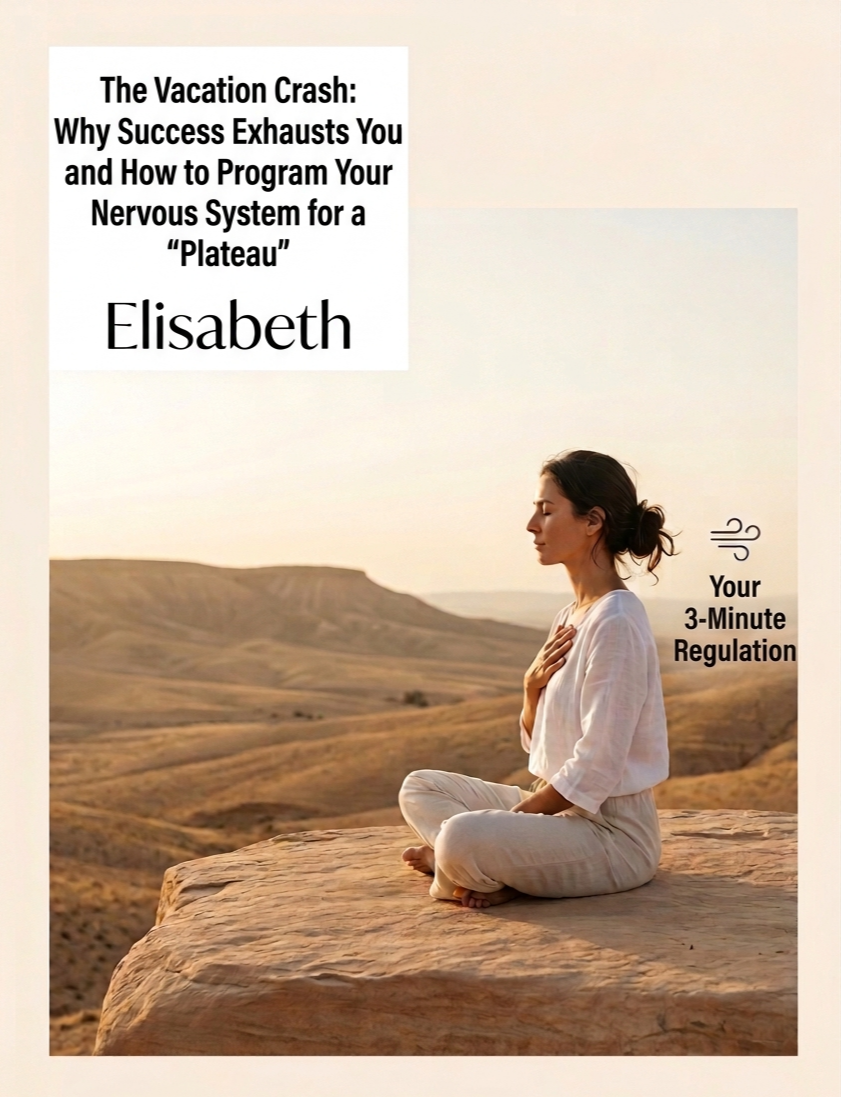
The Vacation Crash: Why Success Exhausts You and How to Program Your Nervous System for a "Plateau"
Moments of Happiness in July
You’ve pushed through for weeks. The quarter is closed, projects are handed over, and your suitcase is packed. Finally, vacation. But just as the pressure drops, it happens: on the second day of your trip, you wake up with a pounding head. Migraine strikes, a cold catches up with you, or a heavy, almost depressive exhaustion pulls you down into bed.
Instead of relaxation, you only feel emptiness and a body that is on strike.
Who hasn't experienced this? This phenomenon is so common among high performers that science even has a name for it: "Leisure Sickness" syndrome. It is not a coincidence, nor is it bad luck. It is the logical, biochemical receipt for a life lived in a constant nervous system zig-zag.
“True fulfillment is not a goal we reach exhausted, but a state we safely anchor within our nervous system in the here and now.
- Elisabeth”
The Science Behind It: The Biochemical Tailspin
Why does the body collapse exactly when we are finally allowed to relax? The answer lies in our neurobiology and the interplay between hormones and the autonomic nervous system.
When you operate in high-performance mode, your sympathetic nervous system (the evolutionary "fight-or-flight" mode) is running at full speed. Your body chronically releases cortisol and adrenaline. These stress hormones don't just keep you awake and focused, they also temporarily suppress your immune system and mask inflammation or pain signals. You function like a machine on a dopamine hunt.
The moment you abruptly brake from 180 to 0 on vacation, the following happens:
The Adrenaline Plummet: Your adrenaline levels drop rapidly.
The Immune Gap: Your immune system, which was artificially blocked for weeks by high cortisol levels, suddenly revives. The result: inflammatory mediators become active, and infections break out.
The Vascular Shock: The sudden drop in sympathetic tone causes the blood vessels in the brain to dilate – the classic trigger for the notorious vacation migraine.
You have fallen into the dopamine trap: steep peak is followed by a crash into exhaustion.
The Solution: Neuro-Resilience Through "Micro-Recoveries"
True resilience means breaking this biochemical pattern before your vacation starts. You don’t need to teach your nervous system how to collapse on a beach for two weeks; you need to teach it how to stay stable in everyday life. The secret lies in micro-recoveries.
It’s about intentionally activating the H&N system (Here and Now) for just a few minutes a day, ensuring your success doesn't remain a short, exhausting peak, but becomes a stable plateau. When you learn to regulate your nervous system throughout the day, your body unlearns the pattern of abrupt collapse.
Your Practical Strategy: The 3-Minute Regulation
You don’t need hours on a meditation cushion to reset your system. Use these science-backed micro-recoveries right between meetings:
The Physiological Sigh: Take two deep breaths in through your nose (one long inhalation followed immediately by a sharp, quick one), then let the air out long and audibly through your mouth. Repeat this three times. It is the fastest biological way to trigger your parasympathetic nervous system (your rest-and-digest nerve).
Savoring (Embodied Awareness): When you celebrate a win or drink a cup of coffee, pause for 60 seconds. Feel the warmth of the mug, the taste, the sense of accomplishment in your body. This shifts the brain from the dopamine hunt (future) to the H&N system (present).
The Systematic Cool-Down: Deliberately slow down the week leading up to your vacation. Reduce your meeting volume by 20% during the final three days.
When you understand your biochemistry, you stop exhausting yourself. Shape your own curve before your body does it for you.